Why Most Cleaning Business Marketing Fails
Here’s a pattern I see constantly: a cleaning business owner spends money on ads, posts randomly on social media, maybe prints some flyers—and then says “marketing doesn’t work for me.”
Marketing isn’t magic. It’s a system. And like every other system in your cleaning business, it only works when you build it intentionally, measure the results, and adjust based on real data.
I’ve helped over a thousand cleaning business owners build profitable companies, and the ones who win at marketing all have one thing in common: they don’t do everything. They do the right things, consistently, and they track what’s working.
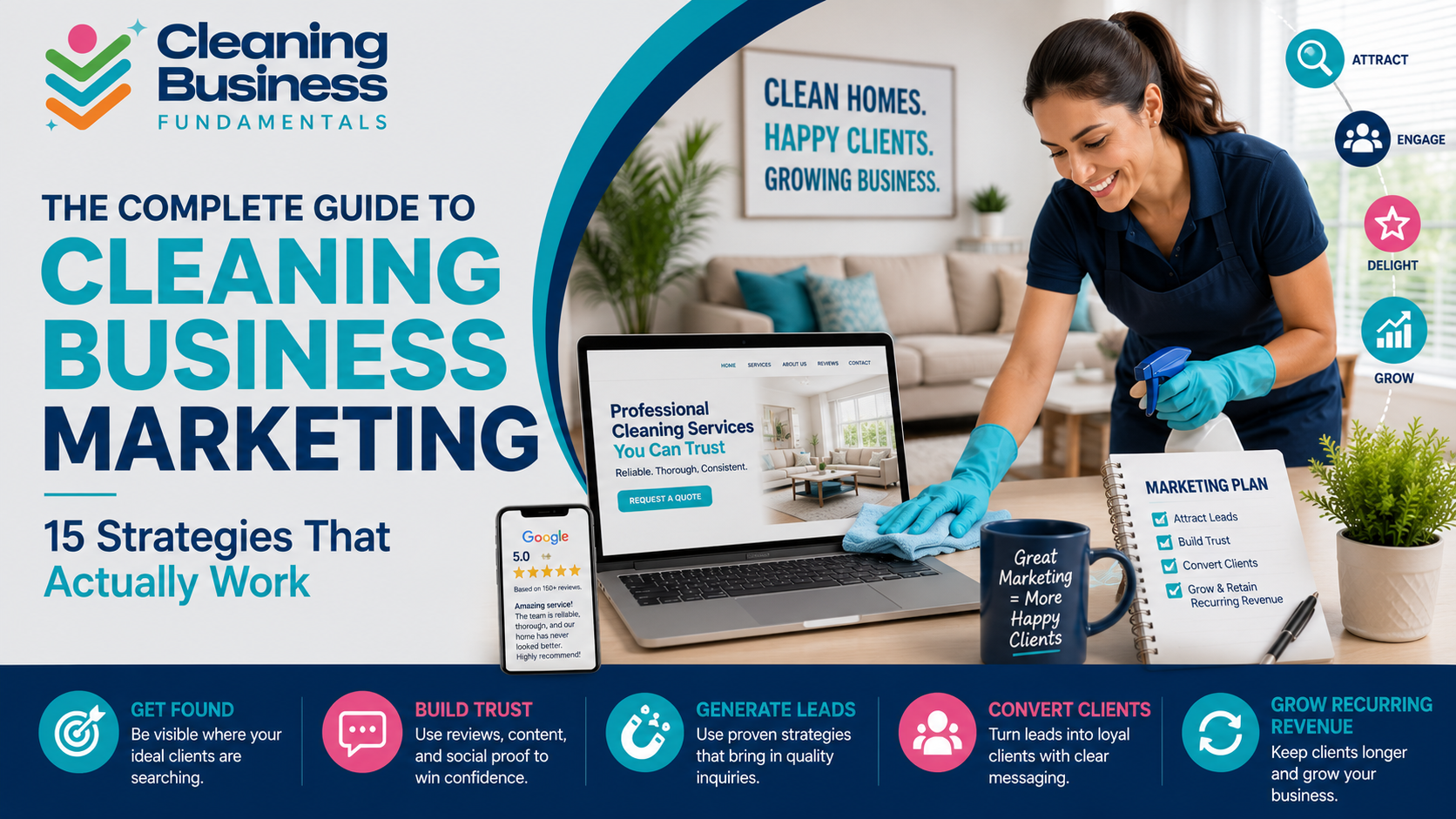
Here are 15 marketing strategies that actually drive growth for residential cleaning businesses—not theory, but proven approaches that real cleaning companies use every day to fill their schedules and build recurring revenue.
Foundation First: Before You Spend a Dollar on Marketing
1. Get Your Google Business Profile Right
This is not optional. Your Google Business Profile (formerly Google My Business) is the single most important piece of free marketing real estate you have. When someone searches “house cleaning near me,” Google decides whether to show your business based largely on your profile.
What to do:
- Claim and verify your profile if you haven’t already
- Fill out every single field—hours, services, service area, business description, attributes
- Upload at least 10 high-quality photos (your team in uniform, before/after shots, your vehicles)
- Post updates weekly—promotions, tips, team highlights
- Respond to every review within 24 hours (yes, every single one)
This alone can generate more leads than most paid advertising—and it’s free.
2. Build a Website That Converts
Your website has one job: turn visitors into leads. That means a clear description of your services, your service area, social proof (reviews and testimonials), and an obvious way to contact you or request a quote on every single page.
You don’t need a fancy website. You need a functional one. If someone lands on your homepage and can’t figure out what you do, where you serve, and how to contact you within 10 seconds, you’re losing leads.
3. Collect and Showcase Reviews
Reviews are the currency of trust. Before someone calls you, they’re reading what other people say about you. Period.
How to systematize reviews:
- Ask after every clean—text message follow-ups work best (70%+ open rates)
- Make it easy: send a direct link to your Google review page
- Train your team to mention it: “If you loved today’s clean, we’d really appreciate a quick Google review!”
- Respond to every review—positive and negative
- Feature your best reviews on your website, social media, and marketing materials
Aim for at least 5 new Google reviews every month. Consistency matters more than volume.
Lead Generation: Strategies That Fill Your Schedule
4. Google Local Services Ads (LSAs)
If you’re going to spend money on one form of paid advertising, Google Local Services Ads should be at the top of your list. LSAs appear above regular Google Ads, they show your reviews and Google Guarantee badge, and you only pay when someone actually contacts you—not when they click.
Most cleaning businesses in competitive markets see LSA leads cost between $15–$40 each. Compare that to the lifetime value of a recurring client ($3,000–$10,000+ per year), and the math is obvious.
5. Google Search Ads (Pay-Per-Click)
Standard Google Ads can work well for cleaning businesses, especially when you target high-intent keywords like “house cleaning service [your city]” or “maid service near me.”
Key rules for cleaning business PPC:
- Target your specific service area—don’t waste budget on cities you don’t serve
- Use negative keywords to filter out irrelevant searches (commercial cleaning, janitorial, jobs, DIY)
- Send clicks to a dedicated landing page, not your homepage
- Track conversions (phone calls, form fills) so you know what’s working
- Start with a modest budget ($500–$1,000/month) and scale what works
6. Referral Programs That Actually Work
Your happiest clients are your best salespeople. But most cleaning business owners leave referrals to chance instead of building a system.
A strong referral program has three elements:
- A clear offer: “$50 off your next clean when you refer a friend who books” (or whatever works for your margins)
- A reward for both sides: The referrer AND the new client both get something
- Active promotion: Mention it in every follow-up email, on your invoices, on your website, and in person
In my experience, a well-run referral program generates 20%–30% of new clients for established cleaning businesses. That’s growth with zero ad spend.
7. Strategic Partnerships and Networking
Who else serves your ideal customer? Real estate agents, property managers, interior designers, home organizers, pest control companies. These are natural referral partners.
How to build partnerships:
- Offer move-in/move-out cleaning services to realtors—give them a few complimentary cleans to experience your work
- Create a “preferred vendor” arrangement with property management companies
- Join your local Chamber of Commerce and BNI (Business Networking International) group
- Sponsor community events where your target customers gather
Content and Social Media: Building Trust at Scale
8. Facebook Marketing for Cleaning Businesses
Facebook remains the strongest social platform for residential cleaning businesses. Your customers are there, your competitors are there, and the targeting options let you reach exactly the right people.
What to post:
- Before/after photos (these get the most engagement, every time)
- Customer testimonials (screenshot the review, ask permission, share it)
- Team spotlights (humanize your brand—people hire people, not logos)
- Quick cleaning tips (position yourself as the expert)
- Behind-the-scenes content (training days, team celebrations, your process)
What not to do: Don’t just post promotional content. Follow the 80/20 rule: 80% value and personality, 20% promotional. Nobody follows an ad account.
9. Join and Engage in Local Facebook Groups
Local community groups, neighborhood groups, and “moms of [your city]” groups are goldmines for cleaning businesses. When someone posts “does anyone know a good house cleaner?” you want to be the first recommendation.
But don’t just lurk waiting for those posts. Be genuinely helpful. Answer questions, share tips, be a visible member of the community. When the recommendation thread comes, people will tag you because they already know and trust you.
10. Email Marketing and Follow-Up Sequences
Email isn’t dead—it’s underused. Every lead that doesn’t book immediately should go into an email nurture sequence. Every current client should get regular communication (not just invoices).
Emails that work for cleaning businesses:
- New lead follow-up: Automated sequence over 7 days for leads who didn’t book
- Post-clean follow-up: “How did we do? Leave us a review!”
- Monthly newsletter: Cleaning tips, promotions, team updates
- Seasonal promotions: Spring deep cleans, holiday prep, back-to-school specials
- Win-back campaigns: Reach out to former clients who stopped booking
11. Blog Content and SEO
If you want free traffic from Google—the kind that comes in month after month without paying for ads—you need content on your website that answers the questions your potential customers are searching for.
Topics like “how much does house cleaning cost in [your city],” “what’s included in a deep clean,” and “how often should you get your house cleaned” are exactly what your future customers are Googling. Write helpful, honest answers, and Google will send them to you.
SEO is a long game. It takes months to see results. But once it’s working, it’s the most cost-effective lead generation channel there is.
Retention Marketing: Keeping the Clients You’ve Won
12. Systematic Follow-Up After Every Clean
The fastest way to lose a client is to take them for granted. A simple “thank you” text or email after each clean—especially the first few—goes a long way.
Better yet, build a client experience that makes every touchpoint feel intentional. Welcome packets for new clients. Quarterly check-ins. Anniversary acknowledgments. These small touches are what separate a forgettable service from a memorable one.
13. Loyalty and Add-On Services
Your existing clients are the easiest sale you’ll ever make. Offer add-on services (inside refrigerators, inside ovens, organizing, laundry) and seasonal upsells (spring deep clean, holiday prep) to increase your average revenue per client without spending a dime on new client acquisition.
Even a modest upsell—$30 fridge cleaning, $50 oven detail—multiplied across your client base adds up fast.
14. Reactivation Campaigns for Lost Clients
Every cleaning business has former clients who stopped booking. Maybe they moved. Maybe they had a budget change. Maybe they just forgot to reschedule. A simple “We miss you!” email or text with a small incentive to rebook can bring back 10%–20% of lapsed clients.
These are people who already know and trust you. Winning them back is infinitely cheaper than acquiring a brand-new client.
Tracking What Works
15. Track Your Lead Sources
If you don’t know where your clients are coming from, you can’t make smart marketing decisions. Tracking lead sources is non-negotiable.
For every new lead, ask: “How did you hear about us?” Track the answer. Review it monthly. Then double down on what’s working and cut what isn’t.
Most cleaning businesses discover that 80% of their clients come from just 2–3 sources. When you know your top sources, you can invest your time and money where it actually matters instead of spreading yourself thin trying to be everywhere.
Where to Start
If you’re feeling overwhelmed, here’s the order I’d tackle these in:
- Google Business Profile (free, high impact, do it today)
- Reviews system (free, start asking this week)
- Referral program (low cost, high ROI)
- Website optimization (make sure it converts)
- Email follow-up sequences (automate and forget)
- Google LSAs or PPC (when you’re ready to invest)
- Social media consistency (pick one platform and own it)
You don’t need to do all 15 strategies at once. Pick three, do them well, and add more as you grow.
The difference between a cleaning business that struggles to find clients and one that has a waitlist isn’t luck—it’s systems. Marketing systems, follow-up systems, tracking systems. That’s what we build inside Cleaning Business Fundamentals, and it’s why our members consistently grow their businesses to $500K, $1M, and beyond.
Ready to stop guessing and start growing? Book a free strategy call with our team to see how CBF can help you build a marketing machine that runs without you.