How Much Should You Charge for House Cleaning?
If you’re guessing what to charge for your cleaning services, you’re leaving money on the table—or worse, you’re working yourself into the ground for free.
I’ve worked with over a thousand cleaning business owners, and pricing is the number one area where I see smart, hardworking people sabotage their own success. They price too low because they’re afraid of losing customers. They copy their competitor’s rates without understanding their own numbers. Or they set a price once and never revisit it, even as their costs climb year after year.
Here’s the truth: your pricing isn’t just a number on a quote. It’s the foundation of your entire business. Get it wrong, and nothing else matters—not your marketing, not your hiring, not your systems. Get it right, and everything gets easier.
Let’s walk through exactly how to set prices that are profitable, competitive, and sustainable.
What the Market Looks Like in 2026
Before we dive into your specific numbers, let’s ground ourselves in what the residential cleaning market actually looks like right now.
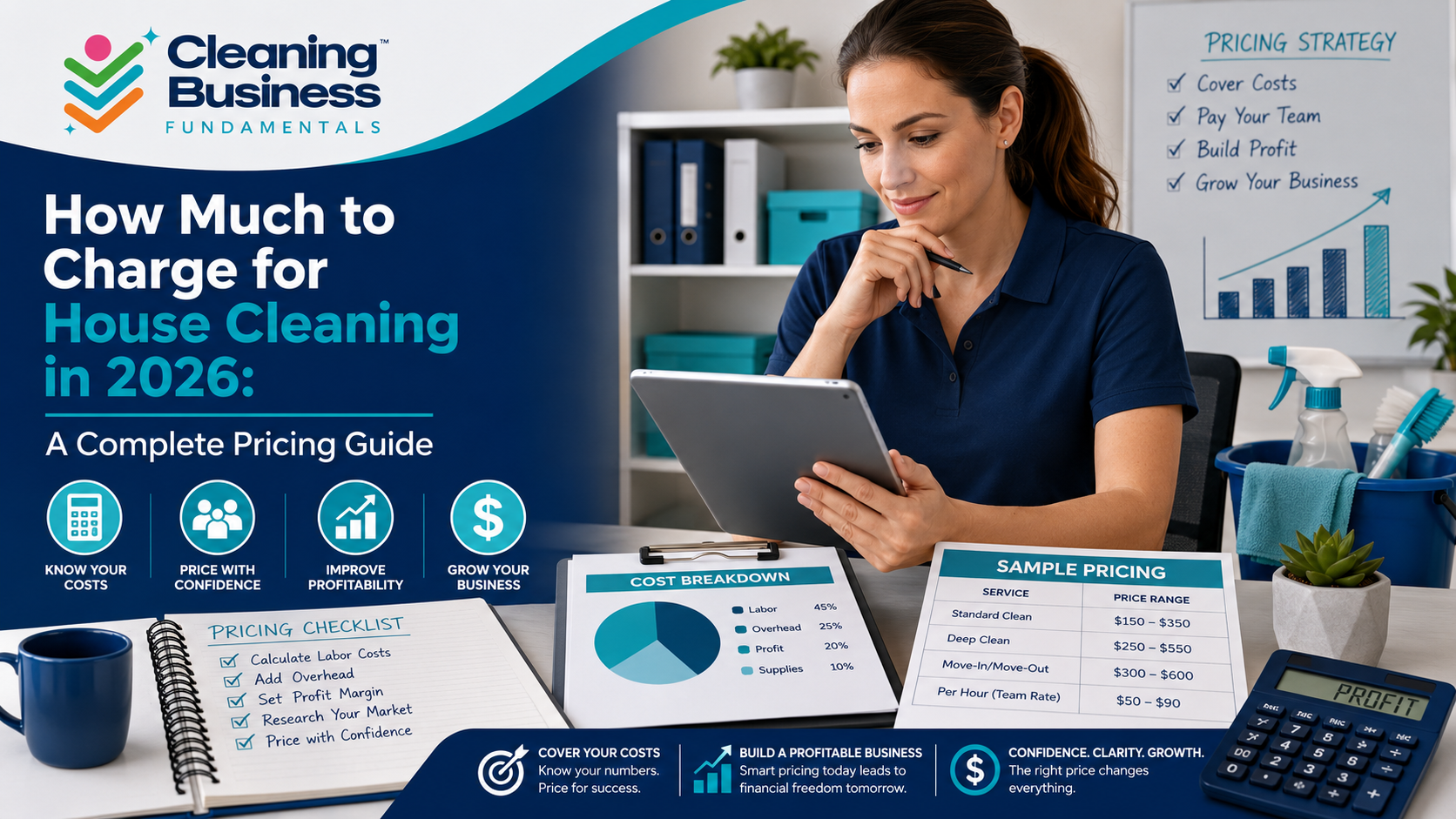
Average rates for residential cleaning in 2026:
- Standard recurring clean: $150–$350 per visit for an average-sized home (1,500–2,500 sq ft), depending on your market
- Deep clean / first-time clean: $250–$550+, typically 1.5x to 2x your recurring rate
- Move-in/move-out clean: $300–$600+, depending on the size and condition
- Per-hour team rates: $50–$90 per hour per team (not per cleaner)
These are national averages. Your market—whether you’re in Dallas, Denver, or Detroit—will shift these numbers. But here’s what I want you to understand: the market average is not your target. Your target is a price that covers your real costs, pays your team fairly, and leaves you a real profit. If the market average doesn’t do that, the market average is wrong for your business.
Step 1: Know Your True Labor Cost
This is where most cleaning business owners get it wrong from the very start. They look at their employee’s hourly wage and think that’s what labor costs. It’s not even close.
Your true labor cost is the wage plus your labor burden—payroll taxes, workers’ comp insurance, paid time off, uniforms, training time, drive time, and every other cost associated with having that person on your team.
For most residential cleaning companies, labor burden adds 20% to 40% on top of the base wage. So if you’re paying a cleaner $16/hour, your real cost is more like $20–$22/hour.
Do this today: Calculate your actual labor burden percentage. If you don’t know it, use our free Labor Burden Calculator to get your real number. Don’t guess.
Step 2: Calculate Your Break-Even Price
Once you know what labor actually costs, you need to layer on your overhead—all the costs of running the business that aren’t directly tied to a specific cleaning job.
Typical overhead for a residential cleaning company includes:
- Cleaning supplies and equipment
- Vehicle costs (gas, maintenance, insurance)
- Office expenses (phone, software, admin staff)
- Marketing and advertising
- General liability and bonding insurance
- Accounting, legal, and professional services
Here’s a simple formula:
Break-Even Price = (Labor Cost per Job + Overhead per Job)
Most healthy cleaning businesses run with labor at 40%–50% of revenue and overhead at 20%–30%. That means for every dollar you charge, about 60 to 80 cents goes to labor and overhead. The rest is your profit.
If your labor and overhead eat up 90% or more of your revenue, you’re running a charity, not a business. And you can’t help your team, your family, or your community from a position of financial stress.
Step 3: Set Your Profit Margin Target
This is the step most owners skip entirely. They price to cover costs and hope there’s something left over. Hope is not a strategy.
Healthy profit margins for residential cleaning businesses:
- 10%–15% net profit: You’re surviving. You can pay yourself, but growth is slow and there’s no cushion for surprises.
- 15%–25% net profit: You’re thriving. You can invest in growth, build reserves, and create real financial freedom.
- 25%+ net profit: You’ve built a machine. This is where CBF members aim—and many of them hit it.
Here’s how this works in practice: if your labor and overhead for a standard 3-hour recurring clean total $120, and you want a 20% profit margin, your price should be $150 at minimum. Not $120. Not $130. $150.
Your price = Total Cost ÷ (1 – Target Profit Margin)
$120 ÷ 0.80 = $150
Flat Rate vs. Hourly: Which Is Better?
I get this question constantly. Here’s my straight answer: flat rate is almost always better for residential cleaning.
Why flat rate wins:
- Predictability for the customer. They know exactly what they’re paying before you walk in the door. No surprises means fewer complaints and cancellations.
- Incentive for efficiency. When your team gets paid per job (not per hour), they’re motivated to work efficiently without sacrificing quality. That’s more jobs per day, which means more revenue.
- Higher perceived value. Hourly pricing commoditizes your service—it makes you sound like a temp agency. Flat-rate pricing positions you as a professional service with a defined scope of work.
- Easier to manage. Flat rates simplify scheduling, payroll, and quoting. Your office manager (or your future office manager) will thank you.
The one exception: if you’re doing specialty work like hoarding cleanouts, post-construction, or jobs where the scope is truly unpredictable, hourly can make sense. But for standard recurring residential cleans? Flat rate, every time.
How to Price Different Service Types
Recurring Cleans (Weekly, Biweekly, Monthly)
Your recurring clients are the backbone of your business. They provide predictable revenue, reduce marketing costs (no need to constantly find new clients), and allow you to optimize routes and schedules.
Because of that value, recurring clients typically get a better rate than one-time customers. But “better rate” does not mean “unprofitable rate.”
- Weekly clients get the best per-visit price (the home stays cleaner, so each visit takes less time)
- Biweekly clients pay slightly more per visit
- Monthly clients pay the most per visit (more buildup = more work each time)
A common structure: if your biweekly rate is $180, your weekly rate might be $150–$160, and your monthly rate $200–$220. Adjust based on your market and your numbers.
First-Time / Deep Cleans
Your initial clean should always be priced higher—typically 1.5x to 2x your recurring rate. This isn’t gouging. The first visit takes significantly more time and effort because you’re bringing the home up to your standard. Baseboards, inside the oven, behind furniture—all the things that haven’t been touched in months (or years).
Don’t discount the initial clean to “win” the client. If someone balks at your first-clean price, they’re probably going to balk at your recurring price too. Better to find that out before you’ve invested hours of labor.
Move-In/Move-Out Cleans
These are premium services. The customer has a deadline (closing date, lease end), the scope is usually larger than a standard clean, and the home is often empty (which means more visible dust and dirt). Price accordingly—at a minimum, charge your deep clean rate. Many owners charge more.
When and How to Raise Your Prices
If you haven’t raised your prices in the last 12 months, you’ve given yourself a pay cut. Inflation, rising wages, increased insurance costs—your expenses go up every year whether you raise your rates or not.
How to raise prices without losing clients:
- Give notice. Send a professional letter or email 30 days before the increase takes effect. Explain that costs have increased and you’re adjusting to continue providing the quality they expect.
- Be confident, not apologetic. Don’t say “I’m sorry, but…” Say “Effective August 1, your recurring clean will be $195. We appreciate your loyalty and look forward to continuing to serve you.”
- Increase by a reasonable amount. 5%–10% annually is standard. If you haven’t raised rates in years, you may need a larger adjustment—but consider phasing it over two increases six months apart.
- Don’t negotiate. If you make exceptions, word will get around. Your price is your price.
Will you lose some clients? Maybe a few. In my experience, 95% or more will stay. And the revenue increase from the clients who stay more than makes up for the handful who leave. Often, the ones who leave were your most difficult, least profitable clients anyway.
Common Pricing Mistakes (and How to Fix Them)
Mistake #1: Pricing Based on Your Competitor
You don’t know their numbers. You don’t know their costs. You don’t know if they’re even profitable. For all you know, they’re going out of business next quarter because they priced too low. Base your prices on your numbers.
Mistake #2: Discounting to Win Clients
Discounting attracts price-shoppers. Price-shoppers are the first to leave when someone cheaper comes along. Build your value, not your discount reputation.
Mistake #3: Not Including Drive Time in Your Costs
Your team is on the clock from the moment they leave for the first job until they finish the last one. If you’re not factoring drive time, routing, and windshield time into your job costs, you’re underpricing every single clean.
Mistake #4: Charging the Same Price for Every Home
A 1,200 sq ft condo with two residents and a 4,000 sq ft house with four kids and three dogs are not the same job. Your pricing should reflect the actual scope of work—square footage, number of bathrooms, number of residents, pets, and condition.
The Bottom Line
Your pricing determines everything: whether you can pay your team fairly, whether you can afford to market and grow, whether you can step away from cleaning and actually run your business, and whether the business you’re building has real value.
Stop guessing. Stop copying. Know your numbers, set your margin, and charge what you’re worth.
If you want help building a pricing system that actually works—one that’s tied to your real costs, your real market, and your real profit goals—that’s exactly what we do inside Cleaning Business Fundamentals. Our members don’t guess at pricing. They know their numbers cold, and they build businesses that create real freedom.
Book a free strategy call to see if CBF is right for your business.