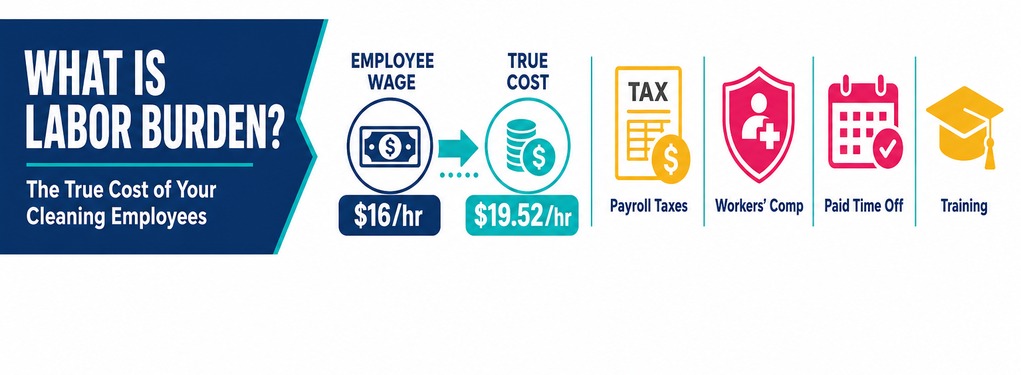
What Is Labor Burden?
If you think paying a cleaner $15 an hour means they cost you $15 an hour, you’re losing money—and you don’t even know it.
Labor burden is the total cost of employing someone beyond their base wage. It includes payroll taxes, workers’ compensation insurance, paid time off, benefits, uniforms, training, supplies, and every other expense tied to having that person on your team. When you add it all up, most cleaning business owners discover their true employee cost is 20% to 40% higher than the hourly rate they agreed to pay.
Here’s a simple way to think about it: your employee’s hourly wage is what shows up on their paycheck. Your labor burden is what actually comes out of your bank account.
Understanding this number isn’t optional—it’s the foundation of profitable pricing, smart hiring decisions, and accurate job costing. If you skip this step, every quote you give, every new hire you make, and every growth plan you build is based on the wrong numbers.
Why Labor Burden Matters for Cleaning Businesses
Residential cleaning companies are labor-intensive by nature. Payroll typically represents 40% to 60% of total revenue—it’s your single biggest expense. That means even a small miscalculation in your labor cost ripples through your entire P&L statement.
Here’s what happens when you don’t know your labor burden:
- You underprice your services. If you’re quoting jobs based on the hourly wage alone, you’re selling at a loss on every single clean. The gap between what you think labor costs and what it actually costs eats directly into your profit margin.
- You can’t hire profitably. Every new employee should generate more revenue than they cost. Without an accurate labor burden figure, you have no way to know whether adding a team member will grow your profit or shrink it.
- You make emotional decisions. Without hard numbers, raises, bonuses, and benefit decisions happen based on gut feelings instead of data. That’s how profitable companies become unprofitable ones.
- You can’t build a real budget. Your labor burden feeds directly into your overhead calculation, your break-even point, and your growth projections. Wrong inputs mean wrong plans.
I’ve worked with over a thousand cleaning business owners, and I can tell you—the ones who build real, scalable businesses all have one thing in common: they know their numbers cold. Labor burden is number one on that list.
What’s Included in Labor Burden?
Your labor burden rate includes every cost associated with having an employee—not just their paycheck. Here’s what most cleaning businesses need to account for:
Mandatory Costs (You Can’t Avoid These)
- FICA (Social Security & Medicare): 7.65% of gross wages. This is the employer’s share—you pay this on top of every dollar you pay your employee.
- Federal Unemployment Tax (FUTA): 6% on the first $7,000 of each employee’s wages (usually reduced to 0.6% with state credits).
- State Unemployment Tax (SUTA): Varies by state, typically 2% to 5% of wages up to a state-defined limit. New employers usually pay a higher rate.
- Workers’ Compensation Insurance: For cleaning businesses, this is often 5% to 15% of payroll depending on your state and claims history. In some states, it’s one of your biggest burden line items.
Common Costs (Most Cleaning Companies Have These)
- Paid Time Off (PTO): If you offer vacation, sick days, or holidays, that’s paid time when no revenue is generated. Even 5 paid days per year adds roughly 2% to your burden.
- Uniforms & Supplies: Company shirts, aprons, name badges, cleaning supplies allocated per employee.
- Training Time: New hire orientation, ride-alongs, ongoing skill training—all paid hours with zero billable production.
- Vehicle/Mileage Costs: If employees drive company vehicles or you reimburse mileage, this is part of the per-employee cost.
- Payroll Processing Fees: Your payroll service charges per employee per pay period.
Optional Costs (Depending on Your Benefits Package)
- Health Insurance Contributions: If you offer health benefits, your employer share is a burden cost.
- Retirement Contributions: 401(k) matching or SIMPLE IRA contributions.
- Bonuses & Incentive Pay: Production bonuses, referral bonuses, and performance incentives.
- Recruiting & Onboarding Costs: Job posting fees, background checks, drug tests, onboarding paperwork time.
How to Calculate Your Labor Burden Rate
Here’s the step-by-step formula. I’ll walk through a real example so you can see exactly how the numbers work.
Step 1: Add Up All Burden Costs Per Employee Per Year
Let’s say you have a cleaner earning $16/hour, working 40 hours/week, 50 weeks/year (2 weeks unpaid). Their annual gross wage is $32,000.
Now calculate each burden item:
- FICA (7.65%): $2,448
- FUTA (0.6% on first $7,000): $42
- SUTA (3% on first $10,000): $300
- Workers’ Comp (8% of payroll): $2,560
- PTO (5 paid days): $640
- Uniforms & supplies: $300
- Training time (40 hours at $16/hr): $640
- Payroll processing ($4/check × 26 pay periods): $104
Total annual burden costs: $7,034
Step 2: Calculate Your Burden Rate Percentage
Burden Rate = (Total Burden Costs ÷ Annual Gross Wages) × 100
$7,034 ÷ $32,000 = 21.98%
That means for every dollar you pay this employee, you actually spend $1.22. Your $16/hour cleaner really costs you $19.52/hour.
Step 3: Calculate the Fully Loaded Hourly Rate
Fully Loaded Rate = Hourly Wage × (1 + Burden Rate)
$16 × 1.2198 = $19.52/hour
This is the number you should be using for all your job costing, pricing decisions, and profitability analysis—not the $16 on the paycheck.
What If You Offer Health Insurance?
Adding a $300/month employer health insurance contribution ($3,600/year) changes the math dramatically:
New total burden: $7,034 + $3,600 = $10,634
New burden rate: $10,634 ÷ $32,000 = 33.23%
New fully loaded rate: $16 × 1.3323 = $21.32/hour
That’s a 33% markup over the base wage. If your pricing doesn’t account for this, you’re subsidizing your employees’ benefits out of your profit—or worse, out of your own paycheck.
Common Mistakes Cleaning Business Owners Make
Mistake #1: Forgetting Workers’ Comp
Workers’ compensation is one of the most expensive line items for cleaning businesses, and it’s the one owners most often forget to include in their labor cost calculations. In high-risk states, it can be 10% to 15% of payroll by itself.
Mistake #2: Ignoring Training Time
New cleaners don’t generate revenue on day one. Between orientation, ride-alongs, and getting up to speed, you might invest 40 to 80 hours of paid time before a new employee is fully productive. If you’re turning over employees frequently, this cost multiplies fast.
Mistake #3: Using the Wrong Number for Pricing
If you price a 3-hour cleaning job at $150 and you have two cleaners on the job, you might think your labor cost is $96 (2 cleaners × 3 hours × $16/hr). But your real labor cost is $117 (2 × 3 × $19.52). That’s $21 less profit per job than you thought—and it adds up across hundreds of jobs per month.
Mistake #4: Not Recalculating Annually
Workers’ comp rates change. SUTA rates change based on your claims history. Benefits costs increase. If you calculated your burden rate two years ago and haven’t updated it, your number is wrong. Recalculate at least once a year—ideally every time you change pay rates or benefits.
What’s a Typical Labor Burden Rate for Cleaning Businesses?
Based on my experience working with over a thousand residential cleaning companies:
- Minimum (no benefits, low workers’ comp state): 15% to 20%
- Typical (standard payroll taxes + workers’ comp + PTO): 20% to 30%
- Full benefits package (health insurance + retirement + PTO): 30% to 40%
If your burden rate is below 15%, you’re probably forgetting something. If it’s above 40%, double-check your numbers—but it may be accurate if you offer comprehensive benefits.
The important thing isn’t hitting a specific percentage. It’s knowing your number so you can price and plan accordingly.
Calculate Your Labor Burden in 60 Seconds
I know that was a lot of math. The good news? You don’t have to do it manually.
We built a free Labor Burden Calculator that does all of this for you. Plug in your wage, your tax rates, and your benefit costs, and it instantly shows you the true cost of each employee.
→ Use the Free Labor Burden Calculator
Knowing your labor burden is step one. Building a profitable, systems-based cleaning business that runs without you? That’s the bigger picture. If you’re ready to stop guessing and start building with real numbers, book a free strategy call with our team. We’ll look at your numbers together and show you exactly where the opportunities are.