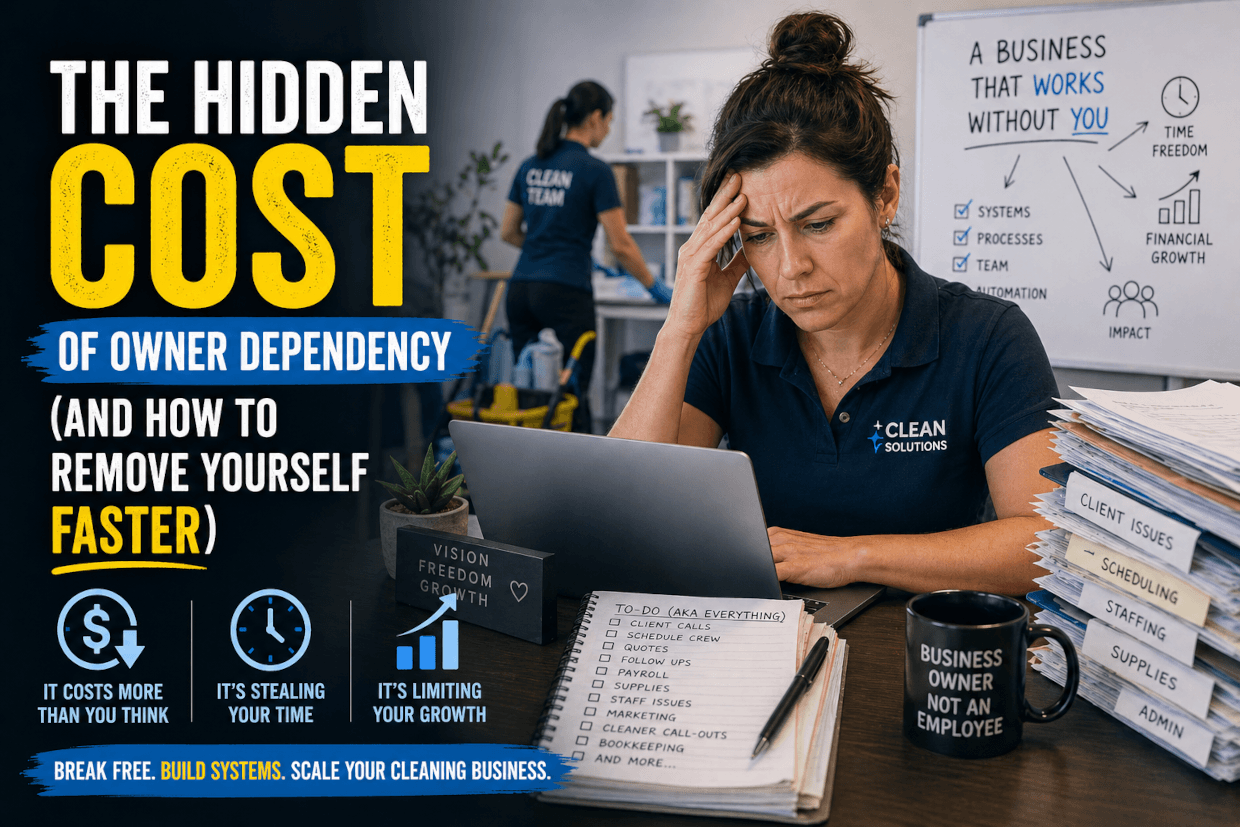
Owner dependency in cleaning businesses is one of the most expensive—and least discussed—growth barriers. While many owners focus on adding clients or hiring more cleaners, they often overlook the real constraint: themselves.
At first glance, being involved in everything may feel responsible. After all, no one cares more about the business than you do. However, this mindset quietly caps your growth, drains your time, and limits your income potential.
This article breaks down exactly how owner dependency in cleaning businesses affects your revenue, how to measure it, and most importantly, how to remove yourself faster using proven frameworks.
What Owner Dependency Really Means
Owner dependency happens when your business cannot function efficiently without your direct involvement.
In practical terms, that means:
- You handle scheduling decisions
- You solve customer complaints
- You approve every quote
- You step in when staff fall short
If you step away for even a few days, things start to slip.
Why Cleaning Businesses Are Especially Vulnerable
Cleaning businesses tend to develop owner dependency faster because:
- They start as solo or small-team operations
- Quality control feels highly personal
- Customers often trust the owner directly
- Systems are rarely built early
As a result, the owner becomes the “hub” of every decision.
The True Cost of Owner Dependency
Let’s get blunt: owner dependency in cleaning businesses is expensive.
Not just in stress—but in real dollars.
Lost Revenue Opportunities
When you’re stuck handling daily operations, you’re not:
- Building partnerships
- Scaling marketing
- Closing larger contracts
- Expanding into new territories
That’s revenue left on the table.
Time as a Hidden Expense
Your time has a dollar value.
If you’re spending:
- 20 hours/week on admin
- 10 hours/week solving problems
That’s 30 hours not spent on growth.
If your time is worth $100/hour, that’s:
- $3,000/week
- $156,000/year
That’s the hidden cost.
Step 1: Conduct a Ruthless Time Audit
You can’t fix what you don’t measure.
Start by tracking your time in 30-minute increments for one week.
The 3-Bucket Method
Divide every task into three categories:
| Category | Description | Example |
|---|---|---|
| $10 Tasks | Low-value work | Scheduling, emails |
| $100 Tasks | Mid-level work | Customer follow-up |
| $1,000 Tasks | Growth work | Sales, strategy |
Your goal is simple:
👉 Eliminate or delegate everything below $1,000 tasks.
Step 2: Calculate Revenue Lost Due to Owner Involvement
Here’s where most owners get surprised.
Opportunity Cost Framework
Ask yourself:
- How many new clients could I close weekly if I had 20 extra hours?
- What is the average lifetime value of a client?
Example:
- 3 new clients/week
- $2,000 lifetime value
That’s:
👉 $6,000/week in missed revenue
👉 $312,000/year
That’s what owner dependency costs you.
Step 3: Identify Bottlenecks in Your Cleaning Business
Now that you’ve measured time and revenue loss, you need to locate friction points.
Common Owner Bottlenecks
Most cleaning business owners get stuck in:
- Scheduling
- Hiring decisions
- Customer issue resolution
- Quality checks
- Sales approvals
Each one creates a delay.
Think of your business like a pipeline. If everything has to pass through you, the flow slows down.
Step 4: The 5-Level Delegation Framework
Delegation isn’t all-or-nothing. It’s progressive.
Level Breakdown
- Do exactly as I say
- Research and report
- Recommend and execute with approval
- Execute and inform
- Own completely
Your goal is to move tasks to Level 5.
Most owners stay stuck at Level 2 or 3—which keeps them trapped.
Step 5: Build Systems Before You Delegate
Here’s a hard truth:
👉 Delegation without systems creates chaos.
You need Standard Operating Procedures (SOPs).
Documentation Essentials
Every repeatable task should include:
- Step-by-step instructions
- Expected outcomes
- Common mistakes
- Time expectations
Start with:
- Scheduling process
- Cleaning checklist
- Customer complaint handling
Step 6: Hiring for Role Replacement
Don’t just hire cleaners—hire to replace yourself.
First Roles to Replace
- Admin Coordinator
- Handles scheduling, communication
- Field Supervisor
- Manages quality control
- Sales Rep
- Closes new clients
Each role removes a chunk of owner dependency.
Step 7: Measure Freedom, Not Just Revenue
Most owners track revenue. Few track freedom.
Freedom Metrics
Start measuring:
- Hours worked per week
- Number of decisions you make daily
- Days business runs without you
These metrics show real progress.
Common Mistakes Owners Make
Avoid these traps:
- Delegating too late
- Hiring without systems
- Micromanaging staff
- Refusing to let go of control
- Underestimating their time value
Each one reinforces owner dependency.
Case Example: Cleaning Business Owner Transformation
Let’s consider a typical scenario.
Before:
- Owner works 70 hours/week
- Handles all scheduling
- Revenue: $25K/month
After implementing systems and delegation:
- Works 30 hours/week
- Staff manages operations
- Revenue: $60K/month
The difference wasn’t more effort.
It was removing dependency.
Frequently Asked Questions
1. How do I know if my cleaning business is owner-dependent?
If operations slow down or stop when you’re absent, your business is owner-dependent.
2. What should I delegate first?
Start with scheduling and administrative tasks. These are high-frequency and low-value.
3. How long does it take to remove owner dependency?
Typically 3–9 months, depending on systems and hiring speed.
4. What if my team makes mistakes?
They will. That’s part of scaling. Systems reduce mistakes over time.
5. Do I need software to reduce dependency?
Yes. Tools for scheduling and communication help streamline processes. For example, platforms like this guide on business systems:
https://www.score.org/resource/blog-post/how-build-systems-your-small-business
6. Can a small cleaning business still scale without the owner?
Absolutely. Many successful cleaning businesses operate fully without daily owner involvement.
Conclusion
Owner dependency in cleaning businesses isn’t just a minor inefficiency—it’s the primary ceiling on your growth.
When everything runs through you, your business becomes limited by your time, energy, and bandwidth.
However, by:
- Auditing your time
- Quantifying lost revenue
- Identifying bottlenecks
- Applying structured delegation
- Building systems
You can transform your role from operator to owner.
And that’s where real scale—and freedom—begins.
Advanced Implementation: Turning Theory Into Daily Practice
Understanding owner dependency in cleaning businesses is one thing. Removing it in real life is another. This is where most owners stall—not because they lack knowledge, but because execution feels overwhelming.
So let’s break it down into practical, repeatable actions you can start this week.
Build a Weekly “Owner Replacement Plan”
Instead of trying to fix everything at once, focus on replacing yourself in one function per week.
Week-by-week example:
| Week | Focus Area | Action |
|---|---|---|
| Week 1 | Scheduling | Train admin + document process |
| Week 2 | Customer communication | Create templates |
| Week 3 | Quality control | Assign supervisor |
| Week 4 | Sales follow-up | Build script + delegate |
This staged approach prevents overload and ensures consistency.
The “Energy Leak” You’re Probably Ignoring
There’s a hidden layer to owner dependency in cleaning businesses that rarely gets discussed: decision fatigue.
Every small decision you make:
- Drains mental energy
- Reduces strategic thinking
- Slows down execution
By midday, many owners are already exhausted—not from physical work, but from constant micro-decisions.
Solution: Decision Elimination Systems
Instead of delegating tasks alone, eliminate decisions entirely.
For example:
- Instead of approving every schedule → create rules
- Instead of answering every complaint → create response templates
- Instead of reviewing every quote → define pricing tiers
This shifts your role from decision-maker to system designer.
Creating “Default Outcomes” in Your Business
A powerful way to eliminate owner dependency is to define what happens without you.
These are called default outcomes.
Examples in a Cleaning Business
- Late employee → automatic replacement protocol
- Customer complaint → standard resolution workflow
- Missed cleaning detail → redo policy without approval
When your team knows exactly what to do, they stop waiting on you.
And that’s the turning point.
The Delegation Flywheel Effect
Delegation isn’t linear—it compounds.
Here’s how the cycle works:
- You delegate a task
- You document it
- You refine it
- You remove yourself
- You gain time
- You reinvest time into growth
Then repeat.
Over time, this creates a flywheel where:
- Your involvement decreases
- Revenue increases
- Stress drops
Technology That Accelerates Owner Independence
While systems matter most, the right tools can speed everything up.
For cleaning businesses, consider:
Core Categories
- Scheduling Software
- Automates bookings and staff assignments
- CRM Systems
- Tracks customers and communication
- Team Communication Tools
- Reduces interruptions
- Quality Control Apps
- Standardizes inspections
You don’t need complex tech. You need tools that reduce manual involvement.
The Psychological Barrier: Letting Go of Control
Here’s the uncomfortable truth:
Most owners don’t struggle with delegation—they struggle with trust.
Common thoughts:
- “No one will do it as well as me”
- “It’s faster if I do it myself”
- “I’ll fix it later anyway”
While partially true, this mindset keeps you stuck.
Reframing the Problem
Instead of asking:
👉 “Will they do it perfectly?”
Ask:
👉 “Will this free me to grow the business?”
Because growth requires imperfection in the short term.
How to Train Your Team for Autonomy
Delegation fails when training is vague.
You need structured onboarding.
The 4-Step Training Method
- Explain the task
- Demonstrate it live
- Let them perform it
- Provide feedback immediately
Repeat until consistency is achieved.
Then remove yourself.
Building a Self-Managing Cleaning Team
A self-managing team doesn’t rely on constant supervision. Instead, it operates on clarity and accountability.
Key Components
- Clear expectations
- Measurable outcomes
- Defined roles
- Regular check-ins (not constant oversight)
When these are in place, your role shifts from manager to strategist.
The Revenue Ceiling You Didn’t Realize You Had
Here’s something most owners don’t calculate:
Your business has a hard revenue ceiling based on your availability.
If you can only:
- Handle 50 quotes/week
- Manage 20 staff decisions/day
Then growth stops there.
Removing owner dependency in cleaning businesses removes that ceiling.
Scaling Beyond Yourself
Once dependency is reduced, something interesting happens:
Growth becomes easier.
Why?
Because:
- Decisions happen faster
- Staff operates independently
- Systems handle volume
At this stage, scaling isn’t about working harder—it’s about expanding systems.
The “Freedom Threshold”
Every business has a tipping point where:
- You’re no longer needed daily
- Operations run smoothly
- Growth becomes predictable
This is the freedom threshold.
Most cleaning business owners never reach it—not because it’s impossible, but because they never remove themselves fully.
Advanced KPI Dashboard for Owner Independence
To maintain progress, track these metrics weekly:
| KPI | Target |
|---|---|
| Owner hours worked | < 30/week |
| Decisions per day | < 10 |
| Tasks delegated | Increasing |
| Revenue per employee | Increasing |
| Days business runs without owner | 5+ |
These numbers tell you if dependency is decreasing.
When to Step Back (And When Not To)
Stepping back doesn’t mean disappearing overnight.
Step Back Gradually
- First remove yourself from daily operations
- Then from decision-making
- Then from oversight
But Stay Involved In:
- Strategy
- Growth planning
- Financial oversight
You’re not leaving the business—you’re upgrading your role.
Final Thoughts: The Fastest Path to Freedom
The fastest way to grow your cleaning business isn’t:
- More clients
- More marketing
- More effort
It’s removing yourself as the bottleneck.
Owner dependency in cleaning businesses is the silent growth killer—but it’s also the easiest to fix once you see it clearly.
Start small:
- Audit your time
- Delegate one task
- Build one system
Then repeat.
That’s how you remove yourself faster—and build a business that truly works without you.